
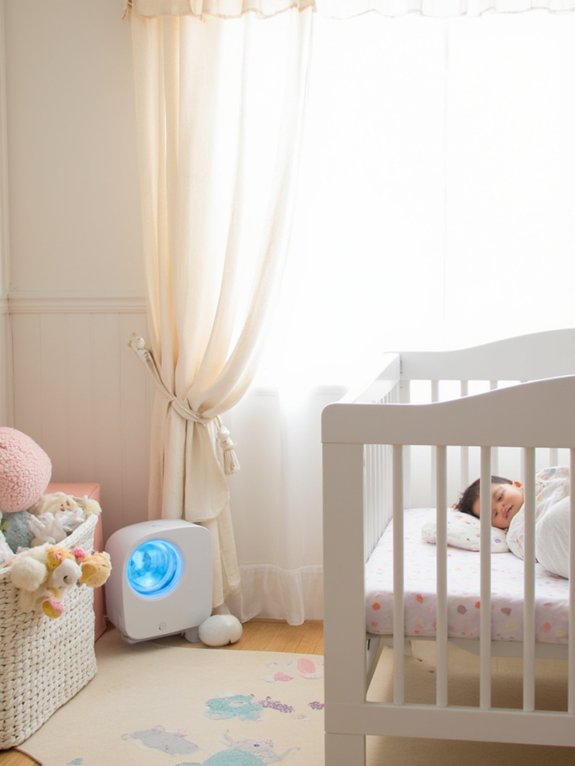


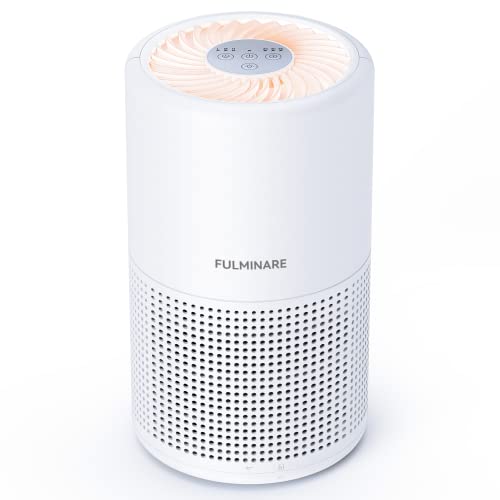


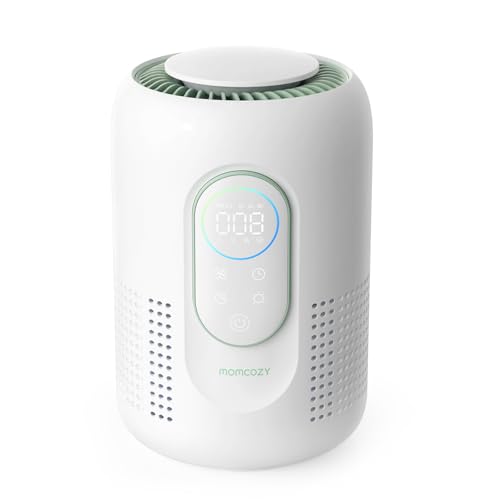


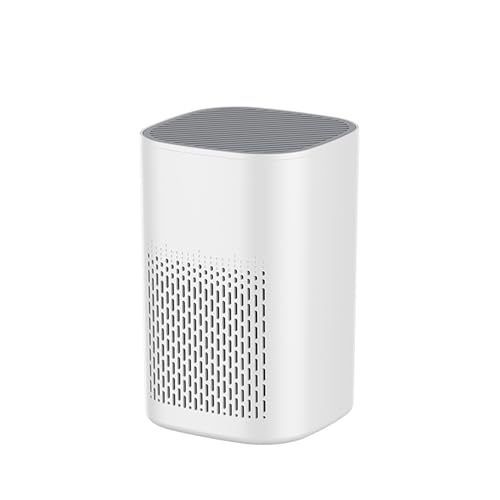


Why Choose a Compact Air Purifier for Nursery?

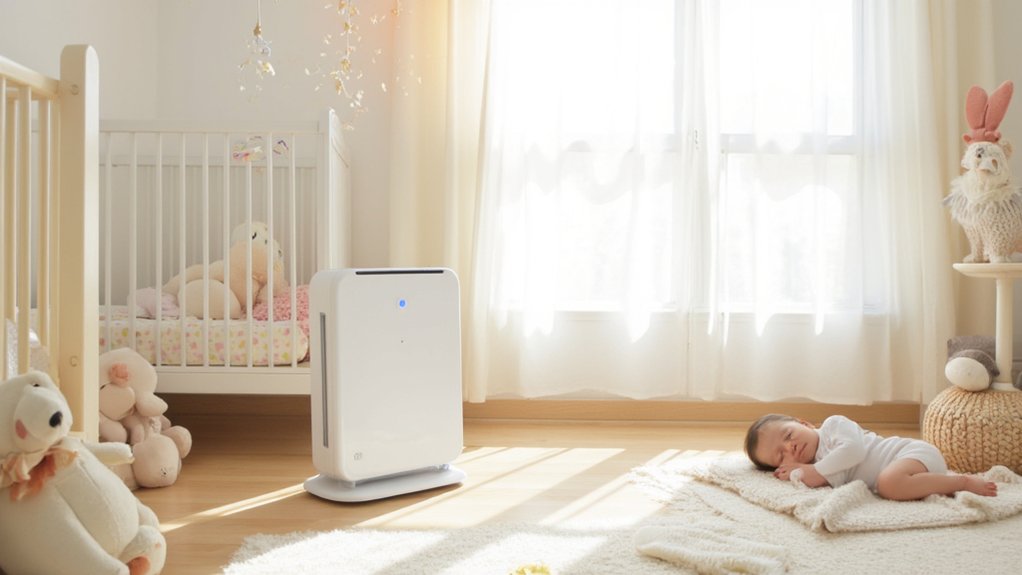
You’ll want a compact air purifier in your nursery to efficiently remove up to 99.97% of airborne particles like dust and pollen while fitting discreetly into limited space. These models use multi-stage HEPA and activated carbon filters to reduce allergens, odors, and VOCs without disrupting your baby’s sleep thanks to noise levels below 40 dB. Plus, their energy-efficient design keeps running costs low. Exploring their placement and filtration tech reveals even more benefits for your infant’s health.
Table
- Main Points
- Benefits of Using a Compact Air Purifier in a Nursery
- Essential Features of Compact Air Purifiers for Baby Rooms
- How Compact Air Purifiers Improve Indoor Air Quality
- Noise Considerations for Nursery Air Purifiers
- Space-Saving Design Advantages in Small Nurseries
- Filtering Capabilities: HEPA and Beyond
- Energy Efficiency and Running Costs of Compact Units
- Placement Tips for Optimal Air Purifier Performance
- Comparing Compact Air Purifiers With Larger Models
- Enhancing Baby’S Health With Clean Air Solutions
- Frequently Asked Questions
- Final Thoughts
Main Points
- Compact air purifiers efficiently clean air in small nursery spaces up to 219 sq. ft. without occupying much room.
- HEPA and activated carbon filters remove allergens, odors, and VOCs, improving overall air quality for infants.
- Quiet operation below 60 dB ensures minimal disturbance, promoting better sleep and comfort for babies.
- Energy-efficient models reduce electricity costs while maintaining continuous air purification in the nursery.
- Proper placement near windows or doorways maximizes pollutant capture and supports healthy infant respiratory development.
Benefits of Using a Compact Air Purifier in a Nursery
When you choose a compact air purifier like the Levoit Core 300S for your nursery, you guarantee efficient air cleaning tailored to smaller spaces up to 219 square feet, all while maintaining a quiet environment with noise levels as low as 39 dB.
Compact air purifiers equipped with HEPA filters capture up to 99.97% of airborne particles, greatly improving indoor air quality by removing pollutants such as dust mites, pet dander, and mold spores. This reduction in allergens directly supports your baby’s health, minimizing respiratory risks and allergic reactions. Many top models also feature activated carbon filters to help remove odors and volatile organic compounds (VOCs), contributing to an even cleaner nursery atmosphere.
HEPA-filtered compact purifiers remove 99.97% of allergens, promoting healthier air and reducing respiratory risks for babies.
Their lightweight, portable design allows you to position the purifier effectively within the nursery or move it as needed. By enhancing air purity efficiently and quietly, these devices create a safer, more comfortable environment for your infant.
Essential Features of Compact Air Purifiers for Baby Rooms
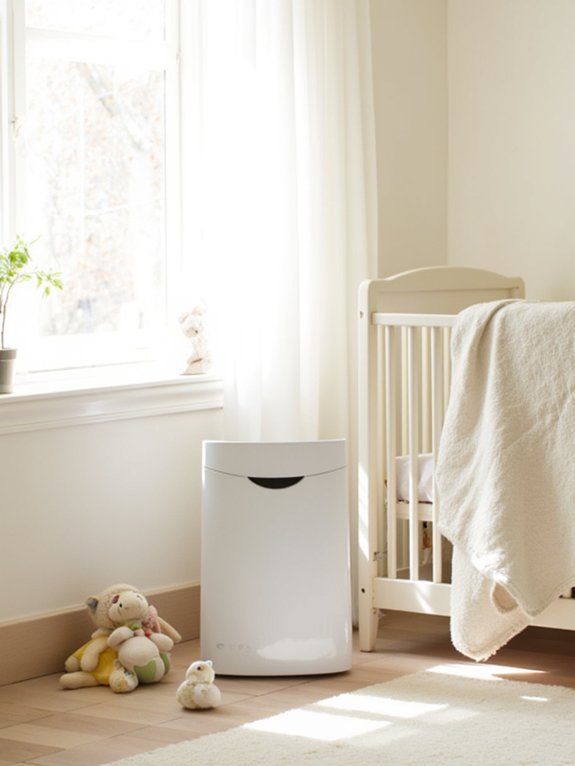
Although nursery spaces are often limited, compact air purifiers deliver powerful performance by integrating high-efficiency particulate air (HEPA) filters that trap 99.97% of airborne contaminants.
When selecting a compact air purifier for a nursery room, consider these essential features:
- HEPA Filters: Confirm removal of fine air pollutants, including dust, pollen, and pet dander.
- Low Noise Level: Choose models operating under 40 dB to maintain a quiet, restful environment. For parents concerned about noise, selecting a purifier with quiet operation ensures undisturbed sleep for your baby.
- Multi-Stage Filtration: Activated carbon filters eliminate odors and volatile organic compounds (VOCs), enhancing air freshness.
- Appropriate CADR: Opt for a Clean Air Delivery Rate calibrated for small rooms to maximize efficiency without overpowering the space.
These technical specifications guarantee that your compact air purifier effectively safeguards your baby's air quality while fitting seamlessly in limited nursery spaces.
How Compact Air Purifiers Improve Indoor Air Quality
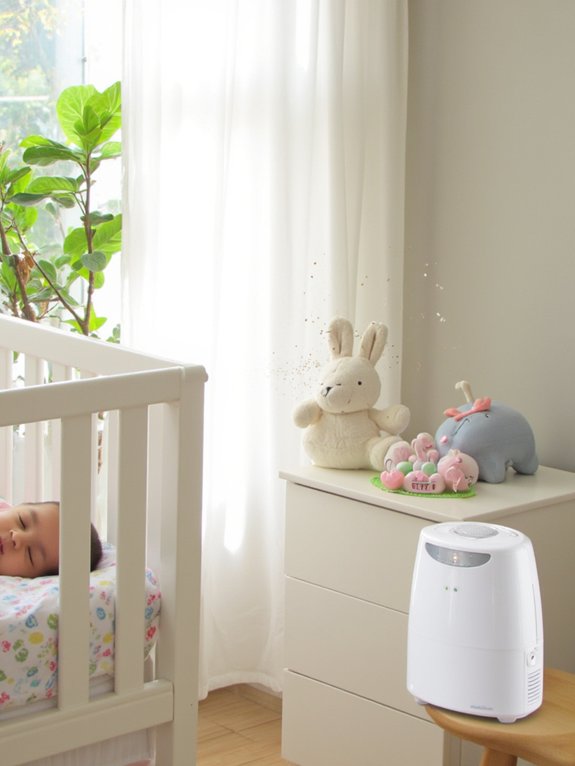
Because indoor air quality directly impacts infant health, compact air purifiers play an essential role in nurseries by efficiently removing airborne contaminants.
Equipped with HEPA filters, these devices trap up to 99.97% of airborne particles such as dust, allergens, and pet dander, greatly enhancing indoor air quality.
Their Clean Air Delivery Rate (CADR) is optimized for smaller spaces, guaranteeing thorough purification without overwhelming the nursery environment.
Optimized CADR ensures effective air purification tailored perfectly for the gentle nursery setting.
Compact designs allow you to position the purifier near pollutant sources, maximizing air circulation and contaminant removal while conserving nursery space.
Additionally, their low noise levels guarantee continuous operation without disturbing your baby’s rest.
By integrating a compact air purifier, you create a healthier, safer nursery environment that supports your infant’s well-being through superior air quality control.
Noise Considerations for Nursery Air Purifiers
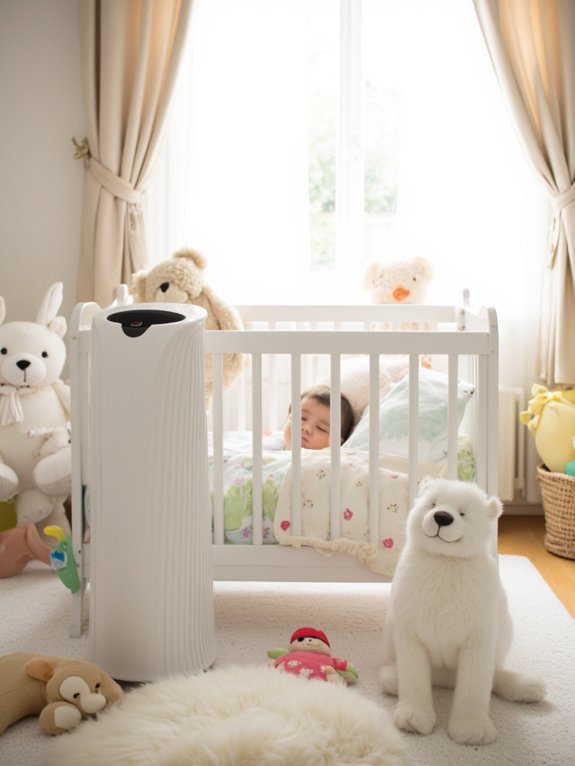
Maintaining superior air quality in your nursery means selecting an air purifier that not only filters effectively but also operates quietly.
Noise is a critical factor as excessive sound can disrupt your baby’s sleep and overall comfort. Consider these points when choosing a unit:
- Aim for an air purifier with noise levels below 60 dB to protect sensitive young ears.
- The Levoit Core 300S offers quiet operation at 39 dB on Speed 1, ideal for nurseries.
- The Alen BreatheSmart Flex runs even quieter at 35.7 dB, ensuring minimal disturbance.
- Avoid louder models like the Blast Mini, whose 56.3 dB may interrupt sleep.
Many modern nursery air purifiers also feature built-in white noise machines, combining powerful air cleaning with soothing sounds to enhance restful sleep. Prioritizing low noise levels supports a calming environment, helping infants fall and stay asleep peacefully.
Space-Saving Design Advantages in Small Nurseries
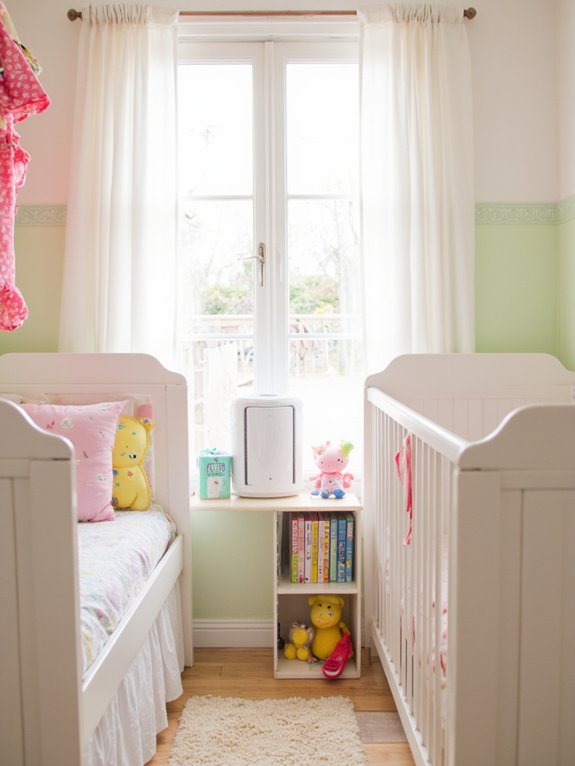
When you’re working with limited nursery space, choosing a compact air purifier becomes vital to maximize both room and air quality.
Compact air purifiers utilize a space-saving design that fits seamlessly into small nurseries, preserving valuable floor area without sacrificing performance. Despite their smaller size, these units deliver impressive Clean Air Delivery Rates (CADR), effectively purifying nursery air in spaces up to 219 sq. ft.
Compact air purifiers save space while providing powerful air purification for nurseries up to 219 sq. ft.
Their sleek, lightweight construction allows flexible placement, enhancing convenience for caregivers. Many compact models, like the MOOKA B-D02L, feature ultra-quiet operation which is ideal for maintaining a restful nursery environment without disruptive noise.
Additionally, they operate with low noise levels, maintaining a peaceful environment essential for infant sleep.
This efficient design also reduces energy consumption, supporting continuous operation without excessive cost. By selecting a compact air purifier, you guarantee peak air quality while respecting the spatial constraints of a small nursery.
Filtering Capabilities: HEPA and Beyond
You’ll find that HEPA filters in compact purifiers capture 99.97% of particles down to 0.3 microns, effectively reducing common allergens in nurseries.
Activated carbon filters further remove volatile organic compounds and odors, improving overall air quality.
Some models even integrate UV-C light technology, enhancing protection by neutralizing bacteria and viruses.
Additionally, many compact air purifiers now feature energy-efficient operation, consuming as little as 56 watts while maintaining strong filtration performance.
HEPA Filter Efficiency
Although compact air purifiers take up minimal space, their HEPA filters trap at least 99.97% of airborne particles as small as 0.3 microns, effectively removing common allergens like dust mites, pet dander, and pollen.
This filtration is essential for maintaining clean air in nurseries, where infants are highly vulnerable to indoor air pollutants. Many models, such as the MOOKA H13, operate at ultra-low noise levels, making them suitable for use during naps and nighttime.
When choosing a compact air purifier, consider these HEPA filter efficiencies:
- Captures microscopic airborne particles that can trigger respiratory issues.
- Fits small nursery spaces without compromising filtration power.
- Requires regular filter replacement to sustain peak performance.
- Supports a healthier environment by reducing allergens and pollutants effectively.
Activated Carbon Benefits
Since HEPA filters excel at capturing microscopic particles, adding activated carbon filtration greatly broadens your air purifier’s capabilities by adsorbing volatile organic compounds (VOCs), odors, and gaseous pollutants that HEPA alone misses.
Activated carbon enhances the air purifier helps remove not only fine particulate matter but also harmful airborne pollutants that threaten indoor air quality. For example, some air purifier and humidifier combos now include real-time air quality updates to help you track and optimize the removal of both particles and gases in your nursery.
When paired with HEPA filtration, this combination can eliminate up to 99.97% of airborne particles and considerably reduce odors, ensuring clean air in your baby’s room.
Keep in mind, the adsorption capacity depends on the activated carbon type and pollutant target.
For ideal performance, replace activated carbon filters every 6 to 12 months, maintaining the air purifier’s effectiveness in protecting your nursery’s delicate environment.
Advanced Filtration Technologies
When selecting a compact air purifier for your nursery, understanding advanced filtration technologies is vital for guaranteeing ideal air quality.
These technologies enhance protection against airborne irritants, safeguarding your infant’s health. Many modern models feature quiet operation and energy efficiency, ensuring they won't disrupt your baby's sleep while maintaining low energy consumption.
- HEPA filters trap at least 99.97% of particles as small as 0.3 microns, including dust and pollen.
- Activated carbon layers adsorb volatile organic compounds (VOCs) and odors, improving indoor air quality.
- UV-C light technology inactivates bacteria and viruses, adding a significant disinfection step.
- Multi-stage filtration systems combine pre-filters, HEPA, and activated carbon to maximize pollutant removal efficiently.
Choosing compact air purifiers with these advanced filtration technologies guarantees thorough removal of contaminants, maintaining a safe nursery environment with reliable Clean Air Delivery Rates (CADR).
Energy Efficiency and Running Costs of Compact Units
While maintaining ideal air quality in a nursery, you’ll appreciate that compact air purifiers like the Levoit Core 300S offer a cost-effective balance of energy efficiency and performance, with an estimated annual running cost of about $79.43.
These units are engineered for smaller spaces, optimizing energy use while effectively purifying air up to 219 square feet. Their lower power consumption translates directly into reduced running costs, making them sustainable for continuous use.
In contrast, units like the Blast Mini, despite higher airflow, incur substantially greater energy expenses, around $285.29 annually.
Additionally, many compact air purifiers maintain quiet operation at approximately 39 dB, which supports a comfortable nursery environment without increasing electricity bills.
Selecting energy-efficient compact air purifiers guarantees you safeguard both air quality and operational costs in your nursery.
Placement Tips for Optimal Air Purifier Performance
Although compact air purifiers are designed for small spaces, you must position them strategically to maximize airflow and filtration efficiency.
Proper placement guarantees ideal air purifier performance and effectively removes pollutants from the air in your baby’s room.
Follow these placement tips:
- Position the unit away from walls and furniture to avoid obstructing airflow.
- Place it near windows or doorways where pollutants enter to capture allergens promptly.
- Avoid corners and choose open spaces to maintain unrestricted air circulation.
- Run the purifier continuously and check regularly to keep its surroundings free from obstructions.
Comparing Compact Air Purifiers With Larger Models
Even if you need to purify the air in a nursery, choosing between a compact air purifier and a larger model depends on room size, noise tolerance, and maintenance preferences.
Compact air purifiers like the Levoit Core 300S serve rooms up to 219 sq. ft., fitting well in confined nursery spaces. They maintain lower noise levels—around 39 dB—supporting restful sleep for infants.
Their energy consumption is also remarkably lower, with annual costs near $79.43, compared to larger models such as the Blast Mini, which can cover up to 702 sq. ft. but consume considerably more energy and may produce louder noise.
Additionally, compact units offer simpler filter replacement, easing maintenance within a nursery environment.
Evaluating these factors guarantees you select an air purifier that effectively balances efficiency, quiet operation, and upkeep in your nursery.
Enhancing Baby’S Health With Clean Air Solutions
You can greatly protect your infant’s respiratory health by using compact air purifiers equipped with HEPA filters that remove at least 99.97% of airborne allergens like dust mites and mold spores.
Clean air reduces the risk of respiratory irritation and supports healthy lung development during critical early stages.
Choosing a purifier that operates quietly and fits small nursery spaces guarantees continuous, effective air filtration without disturbing your baby’s sleep.
Many models, such as those with H13 True HEPA filtration, also feature gentle night lights and ultra-quiet operation to further enhance your child’s comfort and sleep environment.
Benefits of Clean Air
A compact air purifier in your nursery effectively reduces airborne allergens and pollutants, directly enhancing your baby's health.
Utilizing HEPA filters that trap 99.97% of particles, it dramatically improves air quality by removing dust, pet dander, and mold spores. For even greater safety and comfort, models with ultra-quiet operation at 13dB ensure your baby’s rest is undisturbed while maintaining a healthy environment. This reduction in pollutants lowers your infant’s exposure, vital since babies breathe faster and are more vulnerable to respiratory issues.
You’ll notice benefits such as:
- Decreased risk of respiratory infections due to continuous pathogen removal
- Improved sleep quality by eliminating irritants that disrupt rest
- Enhanced overall infant health and development by minimizing contaminant exposure
- Support for long-term well-being by reducing risks linked to asthma and other conditions
Implementing clean air solutions showcases your commitment to safeguarding infant health with evidence-based strategies.
Protecting Infant Respiratory Health
Since infants breathe more rapidly than adults, their exposure to indoor pollutants increases greatly, making clean air essential for protecting their developing respiratory systems.
You can significantly reduce harmful airborne particles in nurseries by using compact air purifiers equipped with HEPA filters. These filters trap up to 99.97% of particles as small as 0.3 microns, effectively removing irritants like dust and pet dander that aggravate infant lungs.
By maintaining cleaner air, you help prevent respiratory issues common in babies exposed to indoor pollutants. Additionally, many compact air purifiers operate quietly, ensuring continuous air purification without disturbing your infant’s sleep.
Implementing these targeted air quality solutions demonstrates your commitment to safeguarding infant respiratory health through evidence-based, practical measures.
Frequently Asked Questions
Should I Get a Big or Small Air Purifier?
You’ll benefit from a big air purifier’s higher CADR, but small air purifiers excel in space considerations for nurseries, quieter noise levels, and energy efficiency factors—ideal for maintaining clean air without disturbing your baby’s sleep.
Do Compact Air Purifiers Work?
You might doubt their power, but compact air purifiers improve air quality effectively with HEPA filters. Their compact design benefits include low noise levels, easy portability, and simple filter maintenance, making them ideal for focused purification.
Will an Air Purifier Help With Baby Congestion?
You’ll improve baby health by enhancing air quality with an air purifier, reducing respiratory issues linked to allergens. This cleaner nursery environment supports better sleep quality, helping prevent congestion and promoting your infant’s overall well-being effectively.
Can a Baby Sleep Next to an Air Purifier?
Think of the air purifier as a gentle guardian, ensuring ideal air quality and baby health. You can safely place it nearby, given low noise levels, proper air circulation, and sleep safety measures to protect your little one.
Final Thoughts
Choosing a compact air purifier for your nursery is like giving your baby a refreshing burst of filtered air every moment. Its space-saving design, quiet operation, and proven efficiency guarantee ideal indoor air quality without overwhelming your room. By focusing on essential features and proper placement, you create a healthier environment that supports your baby’s developing respiratory system. Investing in a compact unit means smart, evidence-based care tailored to your nursery’s unique needs.
If you want to know other articles similar to Why Choose a Compact Air Purifier for Nursery? you can visit the Air Purifiers & Humidifiers category.
3 Best Air Purifiers for Baby Room Dust
How to Choose a Baby Room Air Purifier
Best Portable Air Purifiers for Baby Strollers
7 Tips for Choosing Baby Asthma Air Purifiers
7 Best Air Purifiers for Baby Nurseries
5 Tips for Choosing Baby Allergy Air Purifiers

Why Choose an Air Purifier With Night Light?
5 Tips for Choosing the Best Air Purifier for Newborns
Why Are Air Purifiers Safe for Infants?
This is also interesting