







How to Choose a Filterless Air Purifier for Baby

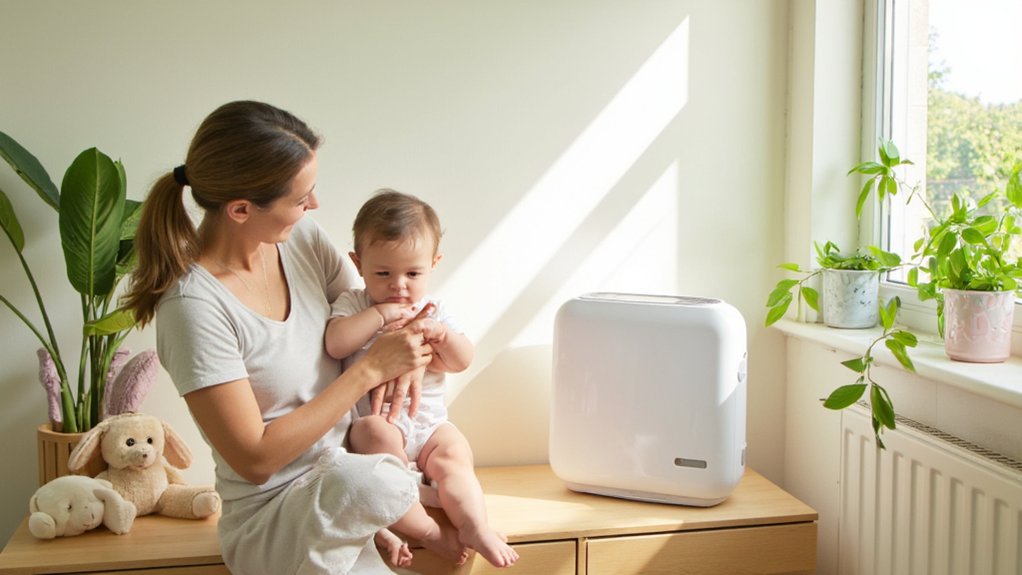
When choosing a filterless air purifier for your baby, prioritize models using safe technologies like UV-C light or ionization that don’t emit ozone. Look for ultra-quiet operation—ideally under 50 dB—to guarantee peaceful sleep. Safety features like child locks and stable design are key to prevent accidents. Consider the room size to guarantee effective coverage and ease of maintenance without expensive filters. Keep these in mind, and you’ll uncover even more ways to create the healthiest environment for your little one.
Table
- Main Points
- Benefits of Using Filterless Air Purifiers in Baby Rooms
- Key Technologies Behind Filterless Air Purifiers
- Safety Considerations for Filterless Air Purifiers Around Babies
- Noise Levels and Operation Modes Suitable for Nurseries
- Evaluating Air Purifier Coverage for Baby Room Sizes
- Important Features to Look for in Filterless Models
- Maintenance Tips for Maintaining Air Quality Without Filters
- Comparing Filterless Air Purifiers With Traditional Filter-Based Units
- Frequently Asked Questions
- Final Thoughts
Main Points
- Choose filterless purifiers using UV-C light or ionization without ozone emissions to ensure safety for babies.
- Prioritize models with noise levels below 50 dB for a quiet, restful baby room environment.
- Select units with child lock features and stable designs to prevent accidental adjustments and tipping hazards.
- Opt for purifiers with easy maintenance and no costly filter replacements to reduce long-term operating costs.
- Look for additional features like night lights or white noise functions to enhance comfort and calmness.
Benefits of Using Filterless Air Purifiers in Baby Rooms
Although you might be concerned about maintaining clean air in your baby's room, choosing filterless air purifiers can offer effective pathogen and allergen reduction without the hassle of frequent filter changes.
These low-maintenance options operate quietly, with noise levels usually under 50 dB, so they won’t disturb your baby’s sleep. Many leading air purifiers for baby rooms are designed to operate at exceptionally low noise levels, often as quiet as 22-27 dB, to ensure restful sleep for infants.
By removing harmful particles and volatile organic compounds (VOCs), they help create a healthier environment tailored to sensitive respiratory systems.
Many models also eliminate odors, ensuring fresher air for your little one. Plus, filterless purifiers don’t produce ozone emissions, making them safer for babies compared to some traditional devices.
By investing in this technology, you’re supporting your child’s well-being with a practical, cost-effective solution that serves their health needs thoughtfully and reliably.
Key Technologies Behind Filterless Air Purifiers

Understanding the key technologies behind filterless air purifiers can help you choose the best option to keep your baby's room safe and healthy.
These purifiers use ionization to release negatively charged ions that attract and neutralize airborne particles, helping reduce pollutants effectively without traditional filters.
Some models incorporate UV-C light technology, which destroys bacteria and viruses by disrupting their DNA, enhancing air cleaning capabilities.
Photocatalytic oxidation (PCO) uses a light-activated catalyst to break down harmful organic compounds and VOCs.
Electrostatically charged plates trap dust and allergens, making cleaning and maintenance simple without filter replacements.
Because filterless air purifiers eliminate costly filters, they often lower long-term costs and reduce waste, making them an eco-friendly choice to maintain a clean, healthy nursery environment for your baby.
Safety Considerations for Filterless Air Purifiers Around Babies

Choosing a filterless air purifier for your baby's room means paying close attention to safety features that protect their delicate health.
You want a unit that supports your child’s developing lungs while ensuring safe, worry-free use. Prioritize models using UV-C light or ionization that don’t emit harmful ozone.
Also, pick one with these essential safety considerations:
- Child lock to guard against accidental adjustments by curious toddlers
- Stable placement on secured furniture to prevent tipping hazards
- Low noise level, ideally under 50 dB, to avoid disrupting your baby’s sleep
Finally, follow the manufacturer’s guidelines on maintenance and safety to keep the purifier effective and safe over time.
By focusing on these factors, you’ll create a healthier environment that truly cares for your little one.
Noise Levels and Operation Modes Suitable for Nurseries

Because your baby's sleep is essential for their development, you'll want a filterless air purifier that runs quietly and adapts its operation to maintain a peaceful nursery environment.
Look for models with low noise levels—ideally whisper-quiet operation around 30 dB—to avoid disturbing your baby’s sleep. Many filterless air purifiers offer multiple operation modes, including sleep mode, which lowers fan speed and dims lights to support a calm atmosphere.
Some units adjust automatically based on real-time air quality, optimizing performance without added noise. Features like soft night lights can further soothe your infant. When considering options, it's also helpful to look for purifiers with ultra-quiet operation and safety features that ensure reliable performance during continuous use.
Choosing a purifier with these quiet, adaptive operation modes helps you create a safe, serene nursery where your baby can rest comfortably and breathe clean air all night long.
Evaluating Air Purifier Coverage for Baby Room Sizes
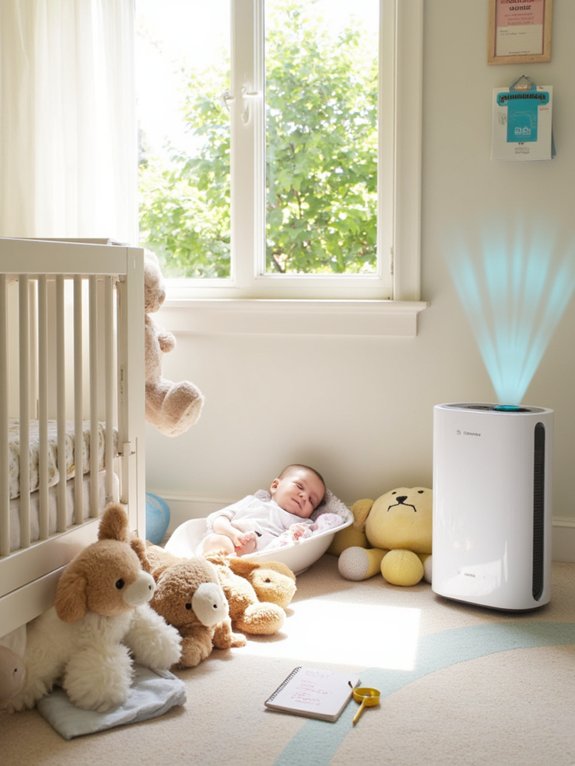
Matching your air purifier’s coverage area to your baby’s room size is essential for maintaining clean air effectively.
To guarantee peak performance, check the square footage your chosen air purifier can cover. For nurseries or smaller baby rooms, models like the Levoit Core 300S are ideal.
Larger spaces demand units with higher Clean Air Delivery Rate (CADR) and wider coverage areas, such as the Blast Mini.
Consider these key points:
- Verify the air purifier’s coverage area matches your baby room’s square footage for efficient purification.
- Position the unit to enhance airflow—keep it at least three feet from the crib.
- Choose a model with quiet operation (below 50 dB) to avoid disturbing your baby’s sleep.
Important Features to Look for in Filterless Models
When choosing a filterless air purifier, focus on the purification technology it uses, like UV-C light or ionization, to guarantee effective germ removal.
Pay close attention to noise levels so your baby’s sleep isn’t disturbed, aiming for models around 50 dB or quieter.
Also, prioritize safety features such as child locks and stable designs to keep your nursery secure and user-friendly.
You may also want to consider models with a noise reduction design, as seen in some advanced air purifiers, to ensure quiet operation during your baby's sleep.
Purification Technology Types
Although filterless air purifiers eliminate the hassle of replacing filters, you need to understand the purification technologies they use to guarantee your baby's safety.
These technologies vary in effectiveness and safety, especially for sensitive infants.
When choosing a filterless air purifier, consider these key purification technologies:
- Ionization: Releases ions to clump airborne particles, but may produce ozone, so prioritize models with low ozone emissions and safety mechanisms like child locks.
- UV-C light: Uses ultraviolet light to kill bacteria and viruses without chemicals, offering a safe, effective method when designed properly.
- Photocatalytic oxidation: Combines UV light and a catalyst to break down pollutants sustainably, minimizing harmful byproducts.
Noise Level Considerations
Understanding the purification technology is just one part of selecting a filterless air purifier for your baby's room.
You also need to take into account noise levels carefully, as infants are sensitive to sound and require a quiet environment for restful sleep.
Look for whisper-quiet air purifiers that operate around 20 dB or lower, ensuring they run silently without disturbing your baby.
Features like sleep mode help reduce fan speed and minimize noise during nighttime.
Some filterless air purifiers use ionization or UV light technology, allowing them to operate silently while effectively cleaning the air. For instance, some models designed for nurseries emphasize quiet operation to minimize disturbance and support restful sleep for infants.
It's important to choose models that offer easy monitoring of noise levels, so you can confidently maintain a peaceful space where your baby can thrive without disruption.
Maintenance Tips for Maintaining Air Quality Without Filters
Since filterless air purifiers rely on technologies like UV light or ionization, you’ll need to maintain them differently than traditional models. Regularly clean surfaces and components to prevent dust buildup, which can hinder their function. Place the purifier in an open nursery area to optimize airflow and pollutant removal. Monitor humidity between 30-50% to support respiratory health and prevent mold. Complement your purifier’s work by dusting and vacuuming frequently. Always follow manufacturer maintenance guides for cleaning UV lamps or ionizer plates.
| Maintenance Task | Purpose |
|---|---|
| Surface Cleaning | Removes dust, maintains efficiency |
| Proper Placement | Enhances airflow, pollutant removal |
| Humidity Control | Prevents mold, protects respiratory health |
| Dusting & Vacuuming | Reduces overall pollutant load |
Comparing Filterless Air Purifiers With Traditional Filter-Based Units
When choosing between filterless and traditional air purifiers, you’ll want to weigh maintenance and operating costs carefully.
Filterless models save you from regular filter replacements but may not capture fine particles as effectively.
On the other hand, traditional HEPA units require ongoing filter changes but provide proven protection for your baby’s air quality.
Filterless vs. Filter-Based
Although filterless air purifiers offer the convenience of no filter replacements and lower maintenance costs, they often fall short of the particle removal efficiency you get with traditional HEPA filter-based units.
When choosing between filterless air purifiers and filter-based units for your baby’s room, consider these key points:
- Filter-based units with HEPA filters provide superior particulate filtration efficiency and have a reliable Clean Air Delivery Rate (CADR) for removing pollutants.
- Filterless models may emit ozone, which is harmful to infants and can impact indoor air quality negatively.
- Noise levels vary; filter-based purifiers often run quietly, while some filterless units produce more noise due to ionization processes.
Balancing safety and effectiveness is vital to protect your baby’s health and guarantee clean, safe air.
Maintenance and Operating Costs
You’ll find that maintenance and operating costs are essential factors when choosing between filterless and traditional filter-based air purifiers for your baby’s room.
Filterless air purifiers often have a comparable initial purchase price to traditional models but save you money over time by eliminating costly filter replacements, which can range from $15 to $80 every six months.
These units typically use energy-efficient technologies like UV-C light or ionization, lowering your electricity bills.
While filterless purifiers require periodic cleaning to maintain peak performance, this maintenance is generally less frequent and less expensive than replacing filters.
Traditional models may have higher energy consumption and ongoing filter costs.
Choosing a filterless option can lead to long-term savings, making it a practical, cost-effective choice to support your baby’s healthy environment.
Frequently Asked Questions
Do Filterless Air Purifiers Really Work?
You’ll find filterless technology can improve air quality and reduce allergens, but watch ozone emissions for baby safety. Consider noise levels, energy efficiency, and maintenance tips to balance cost effectiveness with effective purification methods.
Should You Have an Air Purifier in Baby's Room?
You should have an air purifier in your baby’s room to improve air quality, reduce allergens, and support baby health. Choose one with low noise levels, proper air circulation, suited for room size, and follow maintenance tips.
Is It Better to Have a Humidifier or Air Purifier for a Baby?
Wondering what truly supports your baby’s health? Humidifier benefits soothe dryness and improve baby sleep, while air purifier advantages enhance indoor air quality and allergy relief. Consider respiratory issues and environmental factors to balance moisture and clean air.
Is the Levoit Air Purifier Safe for Babies?
You’ll appreciate Levoit safety features like the child lock and whisper-quiet noise levels. Its HEPA filter guarantees effectiveness, while user reviews praise design options and energy efficiency. Follow maintenance tips, and check warranty details for peace.
Final Thoughts
Choosing a filterless air purifier for your baby’s room means embracing a gentle, hassle-free way to keep the air fresh and safe. By understanding the smart technologies, noise levels, and maintenance ease, you’re making a thoughtful choice that supports your little one’s well-being without extra fuss. While they may differ from traditional models, these purifiers offer a quietly efficient solution, giving you peace of mind as your baby grows in a clean, comforting environment.
If you want to know other articles similar to How to Choose a Filterless Air Purifier for Baby you can visit the Air Purifiers & Humidifiers category.
3 Best Air Purifiers for Baby Room Dust
How to Choose a Baby Room Air Purifier
Why Choose a Compact Air Purifier for Nursery?
Best Portable Air Purifiers for Baby Strollers
7 Tips for Choosing Baby Asthma Air Purifiers
7 Best Air Purifiers for Baby Nurseries
5 Tips for Choosing Baby Allergy Air Purifiers

Why Choose an Air Purifier With Night Light?
5 Tips for Choosing the Best Air Purifier for Newborns
This is also interesting