

Unlocking Fat Loss: The Surprising Truth About 3,500 Calories Per Pound


The common belief that burning 3,500 calories equals losing one pound oversimplifies weight loss. Your body’s metabolism adapts as you lose weight, slowing calorie burn and making constant pound-per-week loss unlikely. Plus, changes in muscle and water affect your weight beyond fat loss. Focusing solely on calorie deficits ignores these complexities. By exploring how your body really responds, you can adopt smarter, personalized strategies that improve your chances of sustainable fat loss over time.
Table
- Main Points
- Understanding the Origin of the 3,500-Calorie Rule
- Why the 3,500-Calorie Deficit Model Falls Short
- How Metabolic Adaptation Affects Weight Loss
- The Role of Body Composition Changes in Fat Loss
- Realistic Expectations for Losing One Pound per Week
- Strategies for Sustainable Weight Loss Beyond Calorie Counting
- The Importance of Personalized Approaches to Diet and Exercise
- Frequently Asked Questions
- Final Thoughts
Main Points
- The 3,500-calorie rule oversimplifies fat loss, ignoring individual metabolic differences and the complex composition of body weight.
- Metabolic adaptation lowers calorie burn during dieting, making sustained fat loss harder than the 3,500-calorie deficit predicts.
- Muscle preservation is crucial since muscle burns more calories than fat, affecting overall metabolic rate during weight loss.
- Daily weight fluctuations often reflect water and glycogen changes, not true fat loss, distorting simple calorie-based calculations.
- Personalized fat loss plans, including diet, exercise, and supplements like Java Burn, yield more effective and sustainable results than calorie counting alone.
Understanding the Origin of the 3,500-Calorie Rule
Although the 3,500-calorie rule has long guided weight loss efforts, it originally stemmed from a 1958 study that calculated fat content in human tissue and concluded that burning 3,500 calories equals losing one pound of fat.
This finding established the idea that the calories in a pound of fat total roughly 3,500.
So, how many calories is a pound of fat? According to this model, it’s consistently 3,500 calories for pound of fat lost.
However, this estimate simplifies the complex makeup of body weight, which includes not only fat but also muscle and water.
While the rule offers a straightforward benchmark, understanding its origin helps you see why it may not fully capture the nuances of weight loss dynamics.
Additionally, effective weight loss often involves lifestyle changes such as a balanced diet and exercise, as seen in approaches like dietary fat absorption blocking to support sustainable results.
Why the 3,500-Calorie Deficit Model Falls Short

While the 3,500-calorie deficit model offers a simple guideline, it often falls short because it overlooks how your metabolism adapts as you lose weight. This model assumes a fixed number of calories equivalent to 1 pound of fat, but real-life results differ considerably.
If you aim at losing a pound a day, the model’s predictions become even less reliable.
Here’s why the 3,500-calorie rule falls short:
- Your basal metabolic rate decreases as you shed pounds, so the calories to pounds conversion changes over time.
- Individual factors like age, gender, and body composition affect how many calories equivalent to 1 pound you actually burn.
- Weight loss isn’t linear, making losing a pound a day unrealistic and often unsustainable.
Understanding these limitations can help you craft a more effective, personalized approach. Supplements like Puravive can support your weight loss journey by boosting brown adipose tissue and enhancing metabolism for better fat burning.
How Metabolic Adaptation Affects Weight Loss
When you reduce calories to lose weight, your metabolic rate adjusts downward, meaning your body burns fewer calories than before.
This adaptation impacts the calorie deficit you create, making it harder to continue losing weight at the same pace.
Understanding these changes helps you set realistic expectations and adjust your approach effectively.
Using supplements like Animal Cuts, which boost metabolism and support fat loss, can help counteract metabolic slowdown during dieting by enhancing fat oxidation and metabolic rate.
Metabolic Rate Changes
Because your body adapts to caloric restriction by lowering its basal metabolic rate, you may find that weight loss slows down over time despite maintaining a consistent calorie deficit.
This metabolic adaptation means your body burns fewer calories at rest, making the simple calculation of how many calories is equal to a pound more complex than the traditional 3,500 calories in a pound rule.
Several factors contribute to these metabolic rate changes:
- Reduced thermic effect of food, decreasing energy spent on digestion
- Lower non-exercise activity thermogenesis (NEAT), reducing daily calorie burn
- Decreased resting energy expenditure as body mass declines
Understanding these shifts helps explain why your weight loss rate may plateau and why metabolic adaptation plays an essential role in your fat loss journey. Enhancing brown adipose tissue levels can help counteract these metabolic slowdowns by increasing calorie burning even at rest.
Impact on Calorie Deficit
Metabolic adaptation directly influences how your calorie deficit translates into actual weight loss.
While it’s commonly believed that a 3,500-calorie deficit equals one pound of fat loss, your body’s slowing metabolism means the relationship isn’t that simple. As you lose weight, your basal metabolic rate drops, so you burn fewer calories at rest.
This adaptation can make it challenging to maintain a consistent caloric deficit and lose a pound a day, or even a pound a week, without adjustments. Understanding how many calories in a pound of fat you need to cut requires factoring in these changes.
To succeed, you must personalize your caloric deficit strategy, considering your unique metabolism, muscle mass, and activity level to optimize sustainable fat loss. Supplements that support metabolic functions, such as those containing natural ingredients like Silymarin, may aid this process by promoting liver health and energy levels.
The Role of Body Composition Changes in Fat Loss
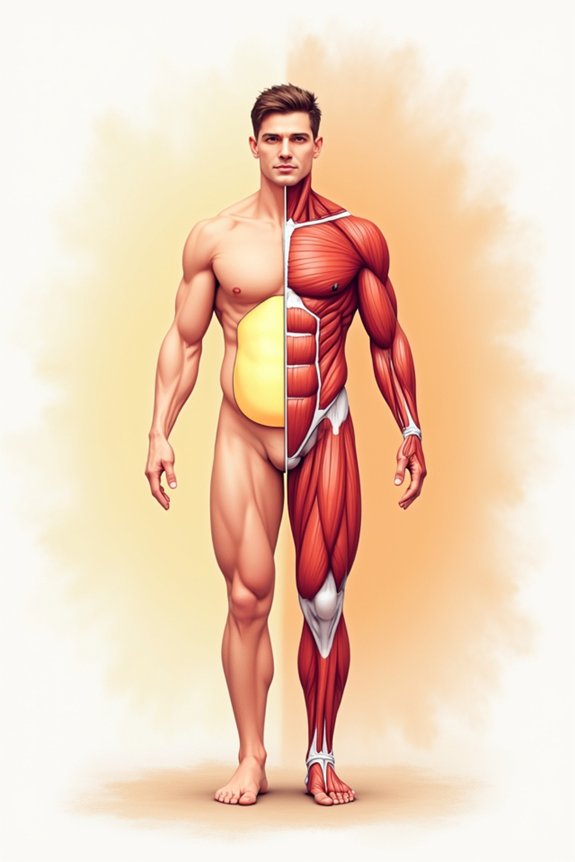
When you lose fat, changes in muscle mass and water weight can shift your body composition, affecting how many calories you burn each day.
Muscle tissue burns more calories at rest than fat, so preserving muscle can help maintain your metabolism during weight loss.
Additionally, your body adapts metabolically, which impacts fat loss rates and may cause plateaus despite consistent calorie deficits.
Natural supplements like Lemme GLP-1 Daily, containing appetite suppressing ingredients, may assist some individuals in managing hunger during weight loss.
Muscle vs. Fat
Understanding the difference between muscle and fat is essential for effective fat loss and overall body composition improvement. Muscle mass burns more calories at rest than fat tissue, meaning your calorie needs depend on this balance. A pound of fat burns about 2-3 calories daily, while a pound of muscle burns 6-10, making preserving muscle vital as you lose weight.
Keep these points in mind:
- Retaining muscle through resistance training supports metabolic rate and fat loss.
- Changes in body composition may not show on the scale but impact your appearance and health.
- Tracking muscle mass and body fat percentage offers better insight than just monitoring pounds lost.
Understanding calories in a lb of fat helps you set realistic goals while focusing on muscle retention. Supporting liver health can enhance your metabolic efficiency, which plays a key role in fat burning and overall weight management.
Water Weight Fluctuations
Although daily weight can fluctuate considerably, much of this variation comes from changes in water retention rather than actual fat loss. Water weight fluctuations often mask your true progress when you’re trying to lose fat.
Early in a diet, rapid weight loss typically reflects depleted glycogen stores, which hold water, not a reduction in fat. Since you’re likely curious about how many calories in a pound of fat you need to burn, remember that 3,500 calories equal 1 lb of fat, but daily scales won’t show this precisely due to water shifts.
Changes in body composition, like increased muscle mass, also affect water retention, complicating fat loss tracking. To understand your real progress, focus on body composition, not just weight, to see beyond temporary water weight fluctuations. Supporting your efforts with supplements that improve metabolic health can also enhance fat loss and energy levels.
Metabolic Adaptations Impact
Since your body adapts to changes in weight by lowering its metabolic rate, you may notice that continuing to lose fat becomes more challenging over time.
This metabolic adaptation means your body requires fewer calories to maintain its new weight, affecting how many calories is a pound of fat you need to burn for further loss.
While 3,500 calories in a lb of fat is a useful benchmark, your changing metabolism can slow progress.
Key factors include:
- Decreased basal metabolic rate reducing daily energy expenditure
- Lower thermic effect of food as body composition shifts
- Nonlinear calorie-to-fat loss relationship causing plateaus
Understanding these shifts helps you set realistic goals and tailor your calorie deficit effectively during fat loss. Supplements like Java Burn can support metabolism and fat burning by enhancing thermogenesis and energy expenditure when combined with a healthy lifestyle.
Realistic Expectations for Losing One Pound per Week

While you might expect to lose one pound each week by cutting 500 calories daily, recent research shows this approach oversimplifies weight loss. The idea that 3,500 calories equal a pound is outdated and doesn’t account for your body’s changing energy needs as you lose weight. This means that consistent weekly losses of one pound aren’t guaranteed.
You might wonder, can you lose a pound a day? Generally, losing one pound daily isn’t realistic or healthy for most people. Instead, setting realistic expectations for weight loss involves understanding that progress varies by individual factors like age and gender.
Focusing on sustainable habits rather than strict calorie targets will better support lasting fat loss and avoid frustrating plateaus. Supplements like Java Burn can help by enhancing metabolism and supporting appetite control within a balanced weight loss plan.
Strategies for Sustainable Weight Loss Beyond Calorie Counting
To achieve lasting fat loss, you need to move beyond just counting calories and focus on sustainable lifestyle changes. While understanding how many calories in a pound of fat (about 3,500) helps frame goals, aiming for how to lose 1 pound a day is generally unrealistic and unhealthy.
Instead, prioritize steady habits that support losing 1 pound of fat over time. Consider:
- Incorporating whole foods and balanced nutrition rather than drastic calorie cuts
- Engaging in regular physical activity tailored to your lifestyle
- Seeking support from professionals and social networks for motivation
These strategies recognize individual differences in metabolism and emphasize consistency over quick fixes. Additionally, creating balanced meal prep plans can optimize nutrients and portion control to support sustainable weight loss.
The Importance of Personalized Approaches to Diet and Exercise
Understanding that sustainable fat loss requires more than just calorie counting leads us to recognize how personalized approaches can make a significant difference in your diet and exercise plan.
You might wonder, is it possible to lose a pound a day? While a pound of fat roughly equals 3,500 calories, creating such a deficit daily is often unsafe and unrealistic. Individual factors like age, sex, and metabolism influence how your body responds to calorie reductions.
That’s why consulting with a registered dietitian is essential—they tailor strategies to your unique needs, ensuring safe and effective progress.
Personalized plans also address exercise preferences and lifestyle, making fat loss manageable and sustainable rather than relying solely on generic calorie goals.
Additionally, incorporating natural supplements that support brown adipose tissue can enhance metabolic rate and improve fat-burning efficiency.
Frequently Asked Questions
Is It Possible to Burn 1 Lb of Fat in a Day?
You can't realistically burn 1 pound of fat in a day because it requires a huge calorie deficit. Instead, focus on steady, moderate changes that support sustainable weight loss and preserve your muscle and metabolism.
How Many Calories Need to Be Burned in Order to Lose One Pound of Body Fat?
You need to burn roughly 3,500 calories to lose one pound of body fat, but individual factors and metabolic changes mean results vary. Focus on consistent, manageable calorie deficits for sustainable weight loss instead of strict numbers.
Will I Gain a Pound if I Eat 3500 Calories in One Day?
If you eat 3,500 extra calories in one day, you won’t automatically gain a pound. Your body adapts—some calories fuel metabolism or activity. Weight gain happens over time, not from a single day's surplus.
How Much of a Calorie Deficit to Lose 10 Pounds a Week?
To lose 10 pounds in a week, you'd need a 35,000-calorie deficit—about 5,000 daily. That’s unsafe and unrealistic. Aim for 500–1,000 calories daily deficit for sustainable, healthy weight loss instead.
Final Thoughts
Losing fat isn’t as simple as burning 3,500 calories once and expecting a pound to vanish like magic. Think of weight loss like steering a ship—small, consistent adjustments keep you on course. Your metabolism adapts, and body composition changes, so rigid calorie rules don’t tell the whole story. By focusing on sustainable habits tailored to you, you’ll create lasting progress that goes beyond quick fixes and fad diets. Stay patient, stay consistent, and trust the process.
If you want to know other articles similar to Unlocking Fat Loss: The Surprising Truth About 3,500 Calories Per Pound you can visit the Weight Loss category.
7 Surprising Foods That Lower Blood Pressure and Melt Belly Fat

7 High-Carb Foods Sabotaging Your Weight Loss Without You Knowing

How a 30-Minute Walk Burns Fat Faster Than You Think

Burn Fat Faster: The Single Exercise Proven to Triple Weight Loss

Unlocking Strawberry Carbs: How Many Berries Fit Your Weight Loss Plan

7 Hidden Reasons Your Weight Won’t Budge—And How to Fix Them Fast

7 Unexpected Habits That Melt Belly Fat for a Noticeably Flatter Stomach

Drop 20 Pounds in 30 Days: The Science-Backed Rapid Reset Plan

Unlock Your Optimal Fat Burning Heart Rate for 2x Faster Results
This is also interesting