


Unlock Your Ideal Daily Calorie Target for Rapid Fat Loss


To access your ideal daily calorie target for rapid fat loss, start by calculating your basal metabolic rate (BMR) using your weight, height, age, and sex. Then multiply this by your activity level to find your total daily energy expenditure (TDEE). Create a sustainable calorie deficit of 500 to 1,000 calories from your TDEE, ensuring you don’t drop below minimum intake levels. Balance your macronutrients for muscle preservation and energy. Understanding these steps sets the stage for smarter fat loss strategies ahead.
Table
- Main Points
- Calculating Your Basal Metabolic Rate (BMR)
- Understanding Total Daily Energy Expenditure (TDEE)
- Setting a Realistic Calorie Deficit for Rapid Fat Loss
- The Role of Macronutrients in Weight Loss
- Adjusting Calorie Intake Based on Activity Levels
- Common Mistakes to Avoid When Reducing Calories
- Tracking Progress and Making Sustainable Changes
- Frequently Asked Questions
- Final Thoughts
Main Points
- Calculate your Basal Metabolic Rate (BMR) using the Mifflin-St Jeor equation as the foundation for daily calorie needs.
- Multiply BMR by an activity factor to find your Total Daily Energy Expenditure (TDEE) for accurate maintenance calories.
- Create a calorie deficit of 500 to 1,000 calories below TDEE for safe, rapid fat loss without compromising metabolism.
- Ensure protein intake is 1.4-2.2 g/kg body weight and balance fats and carbs for nutrition and muscle preservation.
- Track food intake consistently and avoid aggressive calorie cuts or meal skipping to sustain fat loss and prevent plateaus.
Calculating Your Basal Metabolic Rate (BMR)
Before setting your ideal daily calorie target for fat loss, you need to calculate your Basal Metabolic Rate (BMR), which measures the calories your body burns at rest to support essential functions.
To figure out what's my maintenance calories, start by using the Mifflin-St Jeor equation: for men, it’s 10 × weight (kg) + 6.25 × height (cm) – 5 × age (years) + 5; for women, subtract 161 instead of adding 5.
Calculate maintenance calories using the Mifflin-St Jeor equation tailored for men and women.
Understanding your BMR helps you know how to calculate maintenance calories accurately.
Once you know your BMR, you can calculate my calorie deficit by subtracting the calories needed to lose weight safely. This step guarantees your fat loss plan is tailored to your body’s true energy needs.
Understanding Total Daily Energy Expenditure (TDEE)

Once you know your Basal Metabolic Rate (BMR), the next step is to calculate your Total Daily Energy Expenditure (TDEE), which accounts for all the calories your body burns in a day, including physical activity.
TDEE reflects your true calorie needs by multiplying your BMR by an activity factor based on how active you are. Using a calorie needs calculator or daily caloric intake calculator can help you figure out maintenance calories accurately.
For instance, a moderately active 155-pound woman might need around 2,325 calories daily to maintain her weight.
Understanding your TDEE is essential because it sets the foundation for adjusting your intake to lose fat effectively. By knowing how to figure out maintenance calories, you can tailor your eating plan to support sustainable fat loss while preserving muscle.
Supporting metabolic efficiency through proper nutrition and supplementation can further enhance fat-burning and energy levels.
Setting a Realistic Calorie Deficit for Rapid Fat Loss
Although creating a calorie deficit is essential for fat loss, setting one that's both effective and sustainable is key to achieving rapid results without compromising your health.
To calculate calorie deficit, start by determining your Total Daily Energy Expenditure (TDEE) using a weight loss goal calculator. Subtract 500 to 1,000 calories from your TDEE to lose about 1 to 2 pounds per week safely.
When asking, “how many calories should I eat to lose weight?” remember not to drop below 1,200 calories for women or 1,500 for men without professional guidance.
Tracking your intake guarantees you stay on target and adjust as needed. This approach helps you lose fat rapidly while maintaining essential nutrients and muscle mass.
Additionally, supporting your metabolism by increasing brown adipose tissue (BAT) levels can enhance calorie burning and promote natural fat loss, making your calorie deficit more effective.
The Role of Macronutrients in Weight Loss
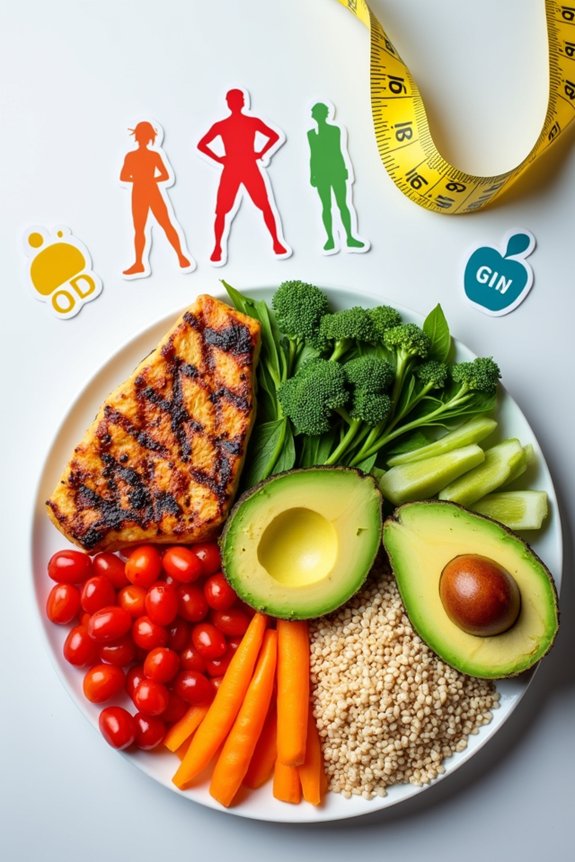
Since losing fat isn't just about cutting calories, understanding how macronutrients impact your body is vital.
When you ask, "how many calories should I eat in a day?" tools like a weight loss calculator or a calorie deficit calculator free can help tailor your intake.
Protein preserves lean muscle, important during weight loss, so aim for 1.4 to 2.2 grams per kilogram of body weight.
Healthy fats, which provide 9 calories per gram, should make up 20-35% of your daily calories to support satiety and hormone balance.
Carbohydrates, 45-65% of your intake, should come from whole grains, fruits, and vegetables to fuel your energy needs and digestion.
Balancing these macronutrients guarantees efficient fat loss while maintaining nutrition.
Using supplements like alli, which blocks approximately 25% of fat absorption, can support your fat loss efforts when combined with a low-fat, reduced-calorie diet.
Adjusting Calorie Intake Based on Activity Levels

When you adjust your calorie intake based on your activity levels, you can create a more effective and sustainable fat loss plan.
Using a daily calorie intake calculator or a how many calories should I eat to lose weight calculator helps you personalize your targets.
Here’s how to fine-tune your plan:
- Determine what're my maintenance calories by calculating your Total Daily Energy Expenditure (TDEE), which accounts for your activity level.
- If you’re sedentary, aim for a lower calorie target, around 1,800–2,400 calories, adjusting downward for fat loss.
- For more active lifestyles, increase your intake accordingly—often 500 to 1,000 calories above sedentary needs—and apply a deficit for weight loss.
This dynamic approach guarantees your calorie goals match your energy output, promoting steady fat loss without compromising metabolism.
Incorporating supplements like Green Coffee Bean Extract can further enhance metabolism and support your fat-burning efforts.
Common Mistakes to Avoid When Reducing Calories
When cutting calories, don’t slash your intake too aggressively, as this can stall your metabolism and harm your progress.
You also need to focus on nutrient balance to keep your energy steady and support overall health.
Skipping meals might seem helpful, but it often backfires by increasing hunger and making it harder to stick with your plan.
Using natural ingredients like psyllium husk can help support digestion and reduce bloating while managing calorie intake.
Overly Aggressive Deficits
Although cutting calories is essential for fat loss, creating an overly aggressive deficit can backfire by causing muscle loss, nutrient deficiencies, and a slower metabolism.
When you wonder, "how many calories should I eat a day?" avoid overly aggressive calorie deficits that exceed 1,000 calories daily. Use a weight loss calc to find a safer target.
Here’s why extreme cuts can hurt:
- Muscle loss reduces your resting metabolic rate, making future weight loss harder.
- Nutrient deficiencies impair your energy and overall health.
- Hormonal shifts can increase cravings, risking binge eating.
Aim for a moderate deficit of 500 to 1,000 calories daily to promote steady, sustainable fat loss while preserving muscle and well-being. Many find that using appetite suppression strategies, such as fat burners designed for women, can help maintain calorie deficits without excessive hunger.
Ignoring Nutrient Balance
Anyone cutting calories for fat loss risks overlooking nutrient balance, which is crucial for maintaining health and energy.
When you ask, "how many calories should I eat?" it’s easy to focus solely on numbers from a weight loss calculator or weight reduction calculator.
However, reducing calories without guaranteeing adequate protein, fats, and carbohydrates can cause nutrient deficiencies, muscle loss, and metabolic slowdown.
Aim for a balanced intake—protein 10-35%, fats 20-35%, and carbs 45-65% of your daily calories—to support your body’s needs.
Also, don’t neglect fiber; it helps control hunger and cravings.
Choosing whole, minimally processed foods guarantees you get essential vitamins and minerals while maintaining a safe calorie deficit.
Balancing nutrients is key to sustainable fat loss and overall well-being.
Supplements with natural ingredients like Silymarin and Resveratrol may also support metabolic functions during calorie reduction.
Skipping Meals Risks
If you skip meals, you may end up feeling excessively hungry later, which often leads to overeating and undermines your calorie deficit. Using a calorie calculator for teens or a weight loss predictor can help you determine the average calories per day you need without skipping meals.
Here’s why avoiding meal skipping matters:
- Skipping slows metabolism and risks muscle loss, making fat loss harder.
- Regular meals stabilize blood sugar, reducing cravings and improving appetite control.
- Missing meals can cause nutrient deficiencies, impacting energy and health.
Instead, aim for balanced meals throughout the day to support sustainable fat loss.
This approach maximizes your calorie deficit and keeps your metabolism active, helping you safely reach your weight loss goals. Supplements with ingredients like Eriomin complex may also support appetite regulation when combined with lifestyle changes.
Tracking Progress and Making Sustainable Changes
When you track your food intake and monitor your weight regularly, you stay closely aligned with your fat loss goals. Use an inch calorie calculator or a weight loss calculator to estimate your daily calorie needs accurately.
Logging your meals with a calorie counter burned tool helps maintain the necessary calorie deficit—typically 500 to 1,000 calories daily for safe weight loss of 1 to 2 pounds per week. Regularly reassess your calorie targets as your weight changes to avoid plateaus.
Keep a consistent eating schedule to support adherence and reduce impulsive eating. Celebrate small milestones and adjust your approach as needed. Sustainable changes, rather than drastic shifts, lead to lasting fat loss and better long-term results. Incorporating supplements that boost brown adipose tissue can enhance fat burning and energy conversion, supporting your calorie deficit efforts.
Frequently Asked Questions
What Is the Daily Calorie Intake for Rapid Weight Loss?
To lose weight rapidly, you’ll want a daily calorie deficit of 500-1,000 calories. Make sure you don’t drop below 1,200 calories for women or 1,500 for men without professional guidance to stay healthy and effective.
How Many Calories Should I Aim to Burn for Fat Loss?
For fat loss, focus on fueling your body with fewer calories than you burn. Aim for a daily deficit of 500-1,000 calories by calculating your TDEE and subtracting to spark steady, sustainable weight loss.
What Is the Ideal Calorie Intake for Fat Loss?
You should aim for a daily calorie deficit of 500-1,000 calories from your Total Daily Energy Expenditure. This supports losing 1-2 pounds weekly, while keeping intake above 1,200 (women) or 1,500 (men) calories for health.
What Is the 30/30/30 Rule for Fat Loss?
The 30/30/30 rule guides you to get 30% of daily calories from protein, 30% from healthy fats, and 30% from carbs, helping you stay full, preserve muscle, and maintain energy while losing fat healthily and sustainably.
Final Thoughts
Think of your calorie target as the compass guiding your fat loss journey. Just like a skilled sailor adjusts their sails to the changing winds, you’ll fine-tune your intake and activity to stay on course. With a clear understanding of your body’s needs and a sustainable calorie deficit, you’re steering toward lasting change—not quick fixes. Keep tracking, stay patient, and trust the process. Your ideal daily calorie target is the key to revealing a healthier, stronger you.
If you want to know other articles similar to Unlock Your Ideal Daily Calorie Target for Rapid Fat Loss you can visit the Weight Loss category.
7 Surprising Foods That Lower Blood Pressure and Melt Belly Fat

7 High-Carb Foods Sabotaging Your Weight Loss Without You Knowing

How a 30-Minute Walk Burns Fat Faster Than You Think

Burn Fat Faster: The Single Exercise Proven to Triple Weight Loss

Unlocking Strawberry Carbs: How Many Berries Fit Your Weight Loss Plan

7 Hidden Reasons Your Weight Won’t Budge—And How to Fix Them Fast

7 Unexpected Habits That Melt Belly Fat for a Noticeably Flatter Stomach

Drop 20 Pounds in 30 Days: The Science-Backed Rapid Reset Plan

Unlock Your Optimal Fat Burning Heart Rate for 2x Faster Results
This is also interesting