









7 Tips for Baby Monitors With Thick Walls

To get clear baby monitor signals through thick walls, start by choosing a monitor with strong range like PMR or WiFi models with FHSS technology. Place the camera high in the nursery, away from electronics, and test different spots for best coverage. Use WiFi extenders to boost signal if needed. Secure cords safely to prevent hazards. Keep monitors away from routers to reduce interference, and regularly check settings and battery levels for reliable performance. With these steps, you’ll reveal even more tips to enhance your monitor’s effectiveness.
Table
- Main Points
- Choose the Right Type of Baby Monitor for Thick Walls
- Optimize Monitor and Camera Placement for Signal Strength
- Use WiFi Extenders to Overcome Structural Barriers
- Manage and Secure Cords to Ensure Nursery Safety
- Minimize Interference From Household Electronics
- Position Monitors to Maintain Clear Audio and Visuals
- Regularly Test and Adjust Monitor Settings for Reliability
- Frequently Asked Questions
- Final Thoughts
Main Points
- Choose PMR or WiFi baby monitors with extended range and FHSS 2.4GHz technology for better signal through thick walls.
- Place monitors centrally and cameras 6-10 feet high away from thick walls and electronics to reduce interference.
- Keep monitors at least three feet from routers and microwaves, and use WiFi extenders to maintain strong signals.
- Securely manage cords with clips, raceways, and avoid placing cords behind the crib for safety around thick walls.
- Regularly test volume, sensitivity, and signal strength, using night vision and zoom to improve monitoring through thick walls.
Choose the Right Type of Baby Monitor for Thick Walls
When you have thick walls in your home, choosing the right baby monitor becomes crucial to maintain a reliable connection.
Standard analogue and digital baby monitors usually offer only about a 50-meter indoor range, which thick concrete or brick walls can easily block.
Instead, consider PMR baby monitors—they provide a range between 500 meters to 2 kilometers, improving signal penetration through barriers. Many parents also find that monitors with FHSS 2.4GHz technology offer enhanced signal reliability in homes with dense construction.
PMR baby monitors offer 500 meters to 2 kilometers of range, enhancing signal strength through thick walls.
Alternatively, WiFi baby monitors are an excellent choice since they rely on your home’s wireless network, offering virtually unlimited range and reducing interference from building materials.
To guarantee maximum performance, always review manufacturer specifications and user feedback related to thick-wall environments.
By selecting baby monitors designed for strong signal penetration, you can confidently monitor your child without worrying about connectivity issues.
Optimize Monitor and Camera Placement for Signal Strength
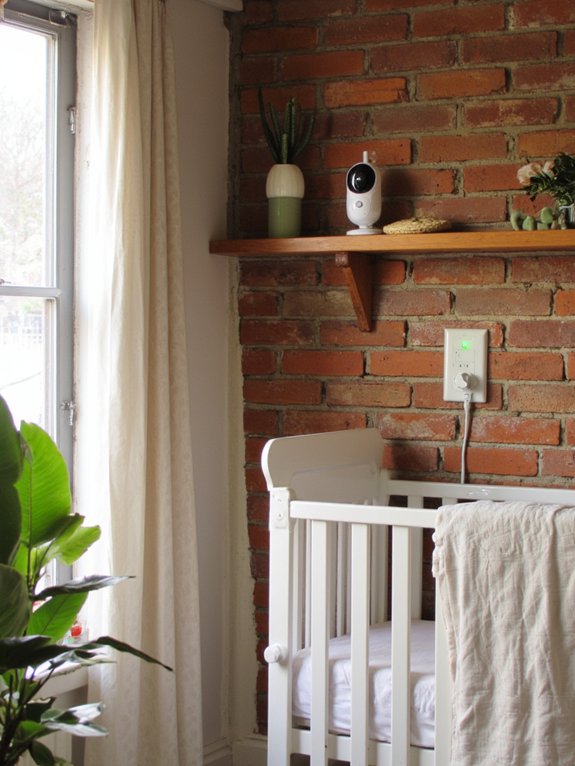
To optimize signal strength, place your baby monitor in a central room at least three feet from thick walls to avoid interference.
Mount the camera securely between 6 and 10 feet high for the best view of your baby.
Testing different spots helps you find the ideal setup that balances coverage and clarity.
Strategic Room Selection
Although thick walls can considerably weaken signal strength, you can optimize your baby monitor’s performance by carefully selecting the room and positioning the device strategically.
Start by placing the monitor in the nursery or baby’s bedroom, where fewer obstructions help maintain a reliable signal essential for baby safety. If you need coverage over larger areas, consider shared playrooms with less acoustic interference. For increased peace of mind, some monitors offer room temperature alerts to help ensure your baby’s environment remains comfortable and safe.
Position the monitor centrally within the chosen room, avoiding thick walls that reduce range. Using a WiFi baby monitor can further improve connectivity, especially across multiple floors.
To extend coverage, integrate a WiFi extender in your home network. Always test different locations to identify the spot with minimal interference from walls and electronics, ensuring a strong, consistent signal to keep your baby safe and monitored effectively.
Optimal Camera Height
Positioning your baby monitor camera between 6 and 10 feet high provides the best balance of visibility and signal strength. This prime camera height reduces obstacles like furniture and thick walls while capturing a full view of the crib. Guarantee the camera stays at least three feet from the crib to maintain safety and improve signal clarity. Adjust the angle diagonally between 45° and 90° to enhance coverage. Regularly test and tweak the position considering your home’s layout for consistent performance. Many monitors use 2.4GHz FHSS technology to reduce interference and help maintain a secure, stable signal even through thick walls.
Avoid Signal Interference
When you place your baby monitor too close to routers or other electronics, the signal can suffer from interference that disrupts monitoring. To avoid signal interference, keep your baby monitor at least three feet away from devices like WiFi routers, cordless phones, and microwaves. Thick walls, especially concrete or reinforced ones, further weaken signals, so test the monitor’s performance in different rooms to spot dead zones. Consider choosing a WiFi baby monitor, as it’s less affected by building materials compared to DECT or analogue models. If your home spans multiple floors, using a WiFi extender can boost signal strength and coverage, ensuring stable connectivity. By optimizing placement, you’ll maintain a reliable connection and keep your baby’s safety front and center. Some baby monitors use 2.4GHz FHSS technology for secure connections and better performance through thick walls.
Use WiFi Extenders to Overcome Structural Barriers
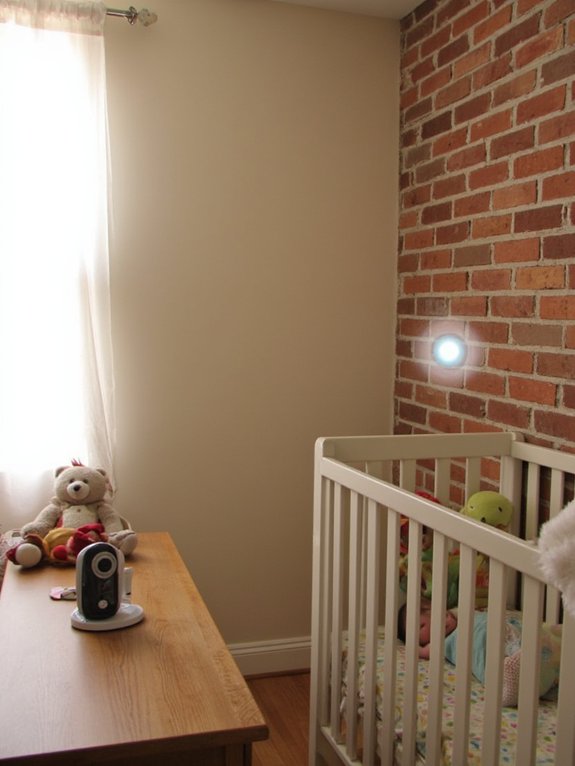
If your home’s thick walls or multiple floors weaken your baby monitor’s signal, using a WiFi extender can dramatically improve connectivity.
WiFi extenders receive your existing signal and rebroadcast it, effectively bridging the gap between your baby monitor and router. This is especially helpful in modern homes with reinforced concrete that blocks signals.
For best results, place the extender equidistant from both the router and monitor to maximize range and strength. Regularly updating the extender’s firmware guarantees peak performance and security, safeguarding your connection against interference.
By enhancing WiFi coverage, you maintain a reliable link to your baby monitor, giving you peace of mind knowing you won’t miss a moment. This simple step guarantees your monitoring system works seamlessly despite structural barriers.
Manage and Secure Cords to Ensure Nursery Safety

Managing and securing every cord in your nursery is essential to preventing strangulation and choking hazards around your baby’s crib. Anchor cords flush against walls using raceways or adhesive tracks, especially within three feet of the crib. Use cord clips or ties to secure excess lengths, eliminating loops. Avoid placing power cords behind the crib to prevent entanglement or accidental pulling. Regularly inspect all cord management setups to keep them secure and intact. For maximum safety, consider cordless baby monitors with rechargeable batteries to eliminate cord risks altogether. When choosing a baby monitor, it’s important to look for options with secure transmission technology to further safeguard your nursery environment.
| Safety Measure | Purpose | Tips |
|---|---|---|
| Anchor cords | Prevent strangulation risk | Use raceways or adhesive tracks |
| Secure excess length | Eliminate choking hazards | Employ cord clips or ties |
| Avoid behind crib cords | Prevent entanglement | Route cords away from crib |
| Regular inspection | Maintain secure setup | Check for wear and tear |
| Cordless monitors | Eliminate cord hazards | Opt for rechargeable units |
Minimize Interference From Household Electronics
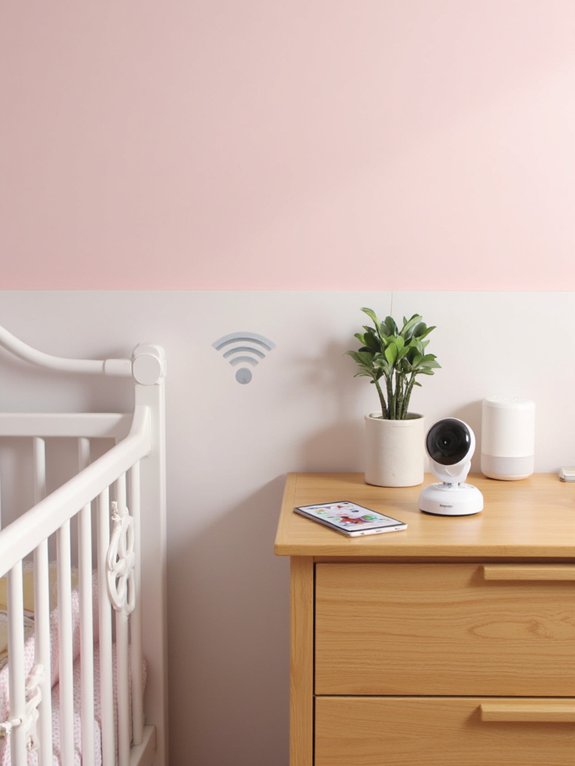
You’ll want to identify common sources of interference like routers and microwaves that can disrupt your baby monitor’s signal.
Position your monitor at least three feet away from these devices and manage WiFi traffic by limiting connected devices during critical monitoring times.
Optimizing placement and network use guarantees a clear, reliable connection for peace of mind.
Identify Common Interferences
Several common household electronics can interfere with your baby monitor’s signal, especially analogue models.
To guarantee reliable monitoring, you need to identify sources of interference that may disrupt audio clarity or connection stability.
Consider these frequent culprits:
- WiFi routers and network congestion, which can degrade signal quality for WiFi or dual-mode baby monitors.
- Microwaves and cordless phones emitting overlapping frequencies that cause static or dropouts.
- Other wireless devices nearby, such as Bluetooth gadgets or baby monitors on the same channel, increasing signal competition.
Optimize Device Placement
Although household electronics can easily disrupt your baby monitor’s signal, you can greatly reduce interference by carefully choosing its placement.
Position the baby monitor on a stable surface at least three feet away from routers, microwaves, and other electronic devices. Avoid placing it near thick walls or metal barriers, which weaken signal strength considerably.
Test the camera’s view and audio clarity before finalizing its spot to guarantee clear monitoring despite obstructions. Choosing a baby monitor with FHSS technology also helps maintain a strong connection in environments crowded with electronics.
By optimizing placement and minimizing interference sources, you’ll provide a reliable monitoring setup that keeps your baby safe and gives you peace of mind even in homes with thick walls.
Manage WiFi Traffic
When managing WiFi traffic, keeping your baby monitor at least three feet from routers and other electronics is essential to reduce signal interference.
High traffic and overlapping frequencies from household electronic devices can weaken your monitor’s connection, especially through thick walls.
To guarantee reliable monitoring, you should:
- Limit the number of devices connected to your WiFi during monitoring times to minimize congestion.
- Use a WiFi extender to boost signal strength and coverage in areas obstructed by walls or floors.
- Regularly inspect and relocate potential interference sources like microwaves or neighboring electronics operating on similar frequencies.
Position Monitors to Maintain Clear Audio and Visuals
How can you guarantee your baby monitor delivers clear audio and visuals despite thick walls?
Start by positioning the baby monitor at least three feet away from thick walls or metal barriers to reduce signal interference and improve connectivity.
Place it away from electronic devices like routers and microwaves, which can disrupt sound quality.
Mount the monitor 6 to 10 feet above the crib to capture a full-body view and avoid obstructions.
Before finalizing the setup, test the camera angle and audio to confirm you’re capturing all necessary sounds and visuals effectively.
For even better performance through thick walls, consider using WiFi baby monitors, as they're less affected by building materials compared to DECT or analogue options.
Proper placement guarantees reliable monitoring for your child’s safety.
Regularly Test and Adjust Monitor Settings for Reliability
Because thick walls can weaken signals and muffle sounds, you need to regularly test and adjust your baby monitor’s settings to maintain reliable performance.
This proactive approach guarantees you catch any issues before they affect your ability to monitor effectively. Consider choosing a monitor that uses secure 2.4GHz FHSS technology, as this provides strong privacy and reliable signal transmission even in challenging environments.
Focus on these key actions:
- Regularly test volume levels and adjust monitor settings for sensitivity to sound and motion, guaranteeing alerts are timely and clear.
- Check pairing and signal strength frequently to prevent disconnections caused by dense wall materials.
- Utilize features like night vision and zoom to overcome visual challenges imposed by thick walls.
Frequently Asked Questions
Can You Use Command Strips for a Baby Monitor?
You can use command strips as sticky solutions to mount your baby monitor securely. Just make certain the strips support the monitor's weight, clean the wall thoroughly, and regularly check for wall safety to keep your baby protected.
How to Attach Baby Monitor to Wall Without Drilling?
Don’t reinvent the wheel—use alternative mounting options like wall adhesive solutions, heavy-duty command strips, or Velcro strips. They securely attach your baby monitor without drilling, keeping walls safe while serving your family’s safety needs effectively.
What Can Interfere With a Baby Monitor?
You’ll face signal interference from thick walls, electronic devices, and crowded WiFi networks, all reducing your monitor range. To serve your baby well, minimize interference by positioning devices strategically and using WiFi extenders when needed.
Do Pediatricians Recommend Baby Monitors?
Pediatricians recommend baby monitors for your infant’s safety, especially those with video and sound alert features. Choose baby monitor types that fit your family’s needs, balancing technology with your parental instincts for effective care.
Final Thoughts
By choosing the right baby monitor and placing it thoughtfully, you’ll cut through thick walls like a lighthouse beam piercing fog. Use WiFi extenders and reduce interference to keep your connection strong and clear. Secure cords to protect your little one and regularly test settings to guarantee reliability. With these steps, you’ll create a seamless watchtower for your baby, giving you peace of mind no matter how thick the walls.
If you want to know other articles similar to 7 Tips for Baby Monitors With Thick Walls you can visit the Baby Monitors category.
Why Choose Baby Monitors With Motion Detection?
What Are the Best Video Baby Monitors for Large Homes?
What Are the Best Non WiFi Baby Monitors?
Best Baby Monitors With Two-Way Audio Features

5 Best Portable Baby Monitors for Travel

5 Tips for Choosing Baby Monitors for Twins

Best Baby Monitors for Multiple Rooms

10 Tips for Baby Monitors With Temperature Sensors

7 Tips for Iphone-Compatible Baby Monitors
This is also interesting